Complete buying guide · Updated 2026
Iron Beds UK: The Complete Buying Guide
An iron bed is one of the few pieces of furniture you can genuinely buy once and never replace. But not all iron beds are built to that standard — and the difference between a frame that lasts a lifetime and one that creaks within two years is almost entirely invisible from a photograph. This guide covers everything you need to make the right choice: materials, styles, sizes, bases, maintenance, and exactly what questions to ask before you buy.
01 — Why iron
Why iron beds remain one of the best frame choices available
Iron beds have been made continuously in the UK since the mid-Victorian era — not because of nostalgia, but because the material properties of solid iron are genuinely well suited to a bed frame. Iron does not warp, does not fatigue, does not absorb moisture, and does not degrade in the way timber and engineered wood products do under the sustained load and repeated movement that a bed frame experiences over years of use.
The modern market has introduced dozens of alternative frame materials — MDF with fabric wrap, pine with a painted finish, engineered timber laminates, hollow metal tube — and all of them share one characteristic that solid iron does not: they deteriorate. The timeline varies, but the direction does not. A solid iron frame built to a proper specification is not subject to the same pressures. It gets more stable with age rather than less, because the joints settle and compress rather than loosen and flex.
Beyond structural performance, iron beds offer something that is increasingly rare in domestic furniture: a genuine sense of permanence. They are heavy, they are substantial, and they are not designed to be disposed of when tastes change. That permanence is partly aesthetic and partly practical — an iron bed is an object that commands a room, and one that can be passed between generations without loss of integrity.
Structural longevity
Solid iron does not warp, fatigue, or degrade under load. A well-built frame maintains its structural integrity indefinitely under normal domestic use.
Low maintenance
A powder-coated or hand-painted iron frame requires no oiling, treating, or re-finishing under normal indoor conditions. Wipe down occasionally and reassemble correctly if moved.
Timeless aesthetic
Iron bed designs have remained desirable across more than 150 years of shifting interior trends. Both traditional and contemporary profiles continue to suit a wide range of room styles.
Sustainable choice
A frame built to last indefinitely has a significantly lower lifetime environmental impact than a bed replaced every five to eight years. Iron is also fully recyclable at end of life.
02 — Materials
Understanding iron bed materials: solid bar iron, hollow tubing, and why it matters
The single most important specification when buying an iron bed is whether the frame is built from solid bar iron or hollow metal tubing. These two materials can be finished to look identical, but they perform entirely differently over time — and the price of the bed is not a reliable guide to which one you are getting.
Hollow metal tubing is the dominant material in mass-produced metal beds. It is inexpensive to manufacture, straightforward to weld, and light enough to keep shipping costs manageable. A hollow tube frame can be powder-coated to look indistinguishable from solid iron at a showroom visit or in a product photograph. The differences only become apparent under use: hollow tube flexes under load, that flexing creates micro-movement at joints, and micro-movement produces noise. The process is gradual but consistent, and it is why the majority of metal beds develop a creak within a few years of purchase.
Solid bar iron is a fundamentally different material. It does not flex. It does not vibrate. Under the compressive and tensile loads that a bed frame experiences during normal use, it behaves as a rigid structure rather than a slightly elastic one. This rigidity is what makes the difference between a frame that stays silent and stable indefinitely and one that does not.
“The only reliable way to establish whether a frame uses solid or hollow construction is to ask directly and check the published weight. A king-size bed genuinely built from solid bar iron will weigh over 60kg — and typically over 70kg. Anything significantly lighter is not solid throughout.”
It is also worth understanding the distinction between wrought iron, cast iron, and solid bar iron, as these terms are sometimes used interchangeably but refer to different things. Wrought iron is worked while hot, producing a tough, slightly fibrous material with high resistance to fracture. Cast iron is poured into moulds and is harder but more brittle — unsuitable for structural load-bearing elements, though occasionally used for decorative castings. Solid bar iron, as used in quality iron bed frames, is a wrought iron product: it combines the strength and workability of wrought iron with a consistent cross-section that makes it ideal for structural use.
03 — Styles
Types of iron bed: Victorian, contemporary, four-poster, and upholstered
Iron beds are available in a wider range of styles than is sometimes appreciated. The category is not limited to ornate Victorian designs — it spans everything from heavily decorated traditional frames to stripped-back contemporary profiles, and now includes hybrid upholstered designs that combine a solid iron structure with a fabric headboard.
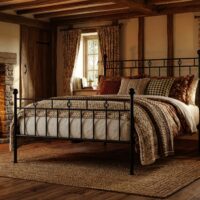
The original and most recognisable style — decorative castings, curved or arched headboards, and ornamental finials. Suits period properties, high-ceilinged rooms, and traditionally furnished interiors. The aesthetic originates from the 1840s–1900s and has remained continuously popular.
Cleaner lines, minimal ornamentation, and a lower visual profile. These frames retain the structural benefits of solid iron construction while sitting comfortably in modern, Scandi-influenced, or transitional interiors. Often a stronger choice where the room’s architecture is already visually busy.
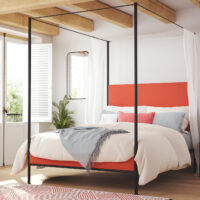
A full four-poster frame built from solid bar iron, available with or without a canopy rail. Suited to larger bedrooms with ceiling heights of at least 2.6 metres. Creates a strong focal point and works particularly well in rooms with period features or generous proportions.
A hybrid design combining a solid iron structural frame with an integrated fabric headboard. Offers the comfort and warmth of an upholstered headboard without compromising the longevity of an iron frame. Available with full fabric and finish customisation.
Iron day beds
A single-width frame designed to function as both a sofa and a bed — suited to guest rooms, studies, and garden rooms where a full bed frame would be disproportionate. Built to the same solid iron standard as the main bed range.
Single iron beds
Available in the full range of styles and built to the same specification as double, king, and super king frames. Single iron beds are a particularly strong choice for children’s rooms, as they will not need replacing as the child grows — the frame outlasts childhood entirely.
04 — Sizes
Iron bed sizes: which size is right for your room?
Iron beds are available in all standard UK sizes — single (90cm), small double (120cm), double (135cm), king (150cm), and super king (180cm). The most popular size in the Nights in Iron range is king, which suits the majority of master bedrooms and provides a substantial visual presence without overwhelming the room.
Because iron beds have a stronger visual presence than upholstered or timber frames — the headboard, footboard, and side rails are all visible and contribute to the room’s appearance — size choice has a greater impact on how the room feels than it does with a more recessive frame style. As a working guide:
Single (90cm wide)
Suits rooms from around 7 square metres. Ideal for children’s rooms, guest rooms, and smaller spare bedrooms. An iron single bed is a particularly long-term investment as it will not need replacing with age.
Small double (120cm wide)
Suits rooms from around 9 square metres. A good choice for guest rooms and spare bedrooms where space is limited but a double sleeping surface is occasionally needed. Provides more room than a single without the visual weight of a full double.
Double (135cm wide)
Suits rooms from around 10 square metres with reasonable clearance on both sides. The minimum comfortable size for two adults sharing. Works well in secondary bedrooms and rooms with lower ceiling heights where a king would feel heavy.
King (150cm wide)
Suits rooms from around 14 square metres. The most popular size and the most visually balanced in a typical UK master bedroom. Benefits from a ceiling height of at least 2.4 metres to feel proportionate with the headboard height.
Super king (180cm wide)
Suits rooms of 16 square metres or more. A super king iron bed makes a commanding statement and requires generous circulation space on both sides — allow at least 70cm between the frame edge and the wall or furniture on each side.
A note on ceiling height
Victorian and four-poster iron bed designs are proportioned for rooms with ceiling heights of 2.4 metres and above. In rooms with lower ceilings, a contemporary profile with a lower headboard typically reads better and avoids the frame feeling cramped against the ceiling.
05 — Base options
Choosing the right base: sprung slats vs solid platform
The base of an iron bed — the surface on which the mattress sits — has a direct effect on how the bed sleeps, not just how it is supported. Nights in Iron offer two base options, each suited to different sleep preferences and mattress types.
A sprung slatted base uses flexible wooden slats under tension to create a slightly responsive surface. As the mattress compresses under weight, the slats flex fractionally in response, providing an additional layer of pressure relief. This works particularly well with pocket sprung and hybrid mattresses, where the additional movement at the base complements rather than counters the spring system in the mattress itself. A sprung slatted base also improves airflow beneath the mattress, which helps regulate temperature during sleep.
A solid platform base provides a firm, flat, completely stable surface. It suits memory foam and latex mattresses, which are designed to perform on a rigid foundation and can be compromised by a flexible base — particularly memory foam, which relies on consistent surface contact to distribute pressure correctly. A solid platform base also produces a hotel-like feel that some sleepers strongly prefer: completely stable underfoot with no give whatsoever.
“If you are unsure which base to choose, the mattress type is the most reliable guide. Pocket sprung or hybrid mattress: sprung slatted base. Memory foam or latex mattress: solid platform base.”
06 — Iron vs wood
Iron beds vs wooden beds: a direct comparison
The choice between an iron bed and a wooden bed is ultimately a question of what you are optimising for. Both materials have genuine strengths, and the right answer depends on the room, the interior style, and how long you expect to keep the frame.
Timber bed frames — particularly those built from solid hardwood such as oak or walnut — offer warmth, natural variation, and a tactile quality that iron does not replicate. A well-made solid hardwood frame can also last many decades. The practical limitations are that timber is more susceptible to changes in humidity (which can cause joints to loosen or creak seasonally), heavier hardwood frames are expensive, and the category is saturated with lower-quality options built from pine or engineered timber that do not perform over the long term.
Iron beds offer different strengths: structural consistency that does not vary with humidity, a visual presence that timber rarely matches, and — in the case of solid bar iron with tensioned joints — a silence and stability that hardwood frames typically cannot equal over time. The aesthetic is more specific: an iron bed has a character and authority that suits some rooms very well and others less so.
Iron vs wood: key differences
- Lifespan — Solid iron: indefinite with correct joint system. Hardwood: decades. Pine or engineered timber: typically 5–10 years
- Seasonal movement — Iron: none. Timber: joints can loosen or tighten with humidity changes
- Weight (king size) — Solid iron: 70kg+. Hardwood: 40–60kg typically. Hollow metal: 25–40kg
- Visual presence — Iron: strong, architectural. Hardwood: warm, natural. Hollow metal: lightweight, recessive
- Maintenance — Iron: wipe down, no treatment required. Timber: occasional oiling or re-waxing depending on finish
- Noise over time — Solid iron with tensioned, bolted joints: silent. Timber: can develop seasonal creaking. Hollow metal: commonly creaks within 1–3 years
- Interior fit — Iron: period, contemporary, industrial, maximalist. Hardwood: Scandi, natural, transitional, traditional
07 — Interior styling
How to style an iron bed: room types, colours, and what works well
An iron bed is one of the few pieces of bedroom furniture that works as a genuine focal point rather than a background element. Because the frame is visible — headboard, footboard, and rails — it contributes actively to the room’s character. This is an asset in the right room and worth planning for.
In period properties with original features — cornicing, wide skirting boards, original fireplaces, or high ceilings — a Victorian or ornate iron design reinforces the architectural language of the space. The dark iron finish is a natural complement to period colour palettes: deep greens, warm whites, terracottas, and navy blues all read well against a matte black or dark anthracite frame.
In contemporary or minimalist rooms, a cleaner iron profile — straight lines, minimal ornamentation, low headboard — provides visual weight without decorative competition. Here, lighter wall colours and natural textiles work better: linen, undyed cotton, and pale neutrals let the iron frame provide the contrast without the room feeling heavy.
Four-poster iron frames work best in rooms where the ceiling height and proportions can absorb the additional vertical presence. They tend to suit rooms where the bed is the clear centre of the space, rather than rooms where furniture is grouped around other focal points. An upholstered iron bed introduces a degree of softness that makes it more versatile across room types — the fabric headboard bridges the visual gap between the iron frame and softer room elements such as curtains, rugs, and upholstered seating.
“A dark iron frame against a deep-coloured wall — forest green, slate blue, or warm charcoal — is one of the most consistently successful bedroom combinations in traditional and contemporary interiors alike.”
08 — What to check
What to look for — and what to ask — before buying an iron bed
The questions below are the ones worth asking any iron bed retailer before committing to a purchase. A confident, specific answer to each of them is a good sign. Vague or evasive responses are informative in a different way.
Is the frame solid bar iron or hollow tubing?
This is the most important question. Ask it directly. Solid and hollow frames can look identical finished and photographed — only the weight and the retailer’s answer will tell you which you are buying.
What does the assembled frame weigh?
Published frame weights are one of the most reliable quality indicators available. A king-size solid iron bed should weigh over 60kg — typically 70kg or more. Significantly less than this indicates hollow or mixed construction.
What joint system does the frame use?
Standard slot connections loosen over time and are the primary cause of creaking. A tensioned, bolted joint system — in which the connection is kept under constant mechanical pressure — stays silent indefinitely. Ask specifically about the joint engineering, not just the assembly method.
What guarantee is offered on the frame?
A lifetime structural guarantee reflects genuine confidence in the build. A two or five year guarantee on a frame claimed to last decades should prompt further questions. Nights in Iron offer a lifetime guarantee on all their iron frames.
What is included with delivery?
Tools, step-by-step instructions, and assembly video guides should be standard inclusions. An iron bed assembled without the correct tools or guidance is more likely to be incorrectly tensioned — which undermines the silent joint system regardless of how well the frame is built.
What finish is applied over the iron?
Powder-coat and hand-painted finishes over solid iron are durable and long-lasting under normal indoor conditions. Spray finishes over hollow tube are more likely to chip and less likely to adhere evenly. Ask what the finish type is and whether it is applied over solid or hollow substrate.
09 — Care and maintenance
How to care for an iron bed frame
One of the most practical advantages of a solid iron bed is how little it demands in terms of maintenance. Unlike timber, it does not need treating or oiling. Unlike hollow metal, it does not flex and therefore does not work its joints loose over time. Under normal indoor conditions, a well-finished solid iron frame will not rust, will not degrade, and will not require any intervention to remain in good condition.
Day-to-day care is minimal: dust the frame regularly with a soft cloth, and if the finish becomes marked, wipe down with a slightly damp cloth and dry immediately. Avoid abrasive cleaning products, wire brushes, or anything that could scratch through the finish to the iron beneath. If the finish is damaged in a specific area, touch-up paint in the original colour can be applied to the affected section without refinishing the whole frame.
If the bed is ever disassembled for moving or storage, reassemble it carefully following the original instructions and ensure the tensioned joint connections are properly re-engaged. A correctly reassembled Nights in Iron frame will be as silent and stable after a move as it was before — the joint system is not affected by disassembly provided it is correctly re-tightened on reassembly.
There is no need for any seasonal maintenance, annual bolt-checking, or periodic re-treatment. The frame either needs attention or it does not, and under normal use it almost never does.
10 — FAQs
Frequently asked questions about iron beds
Are iron beds good?
Yes — provided they are built from solid bar iron with a quality joint system. Iron beds built to that standard offer structural longevity that very few other frame materials can match, combined with a visual presence and character that is genuinely distinctive. The caveat is that not all beds sold as iron beds meet this standard: many use hollow tubing finished to look like solid iron, which performs very differently over time. The material and the joint engineering are what determine whether an iron bed is a good purchase or not.
Do iron beds squeak?
Poorly engineered ones do. Squeaking in any metal bed frame is caused by movement at the joints — specifically by the small gap that forms when slot connections loosen under repeated use. Once a gap exists, metal moves against metal under load, and that movement produces noise. The solution is a strong, bolted joint system that keeps the connection under constant mechanical pressure, preventing any gap from forming. Nights in Iron frames use this approach, which is why they are described as permanently silent rather than just quiet when new.
How long do iron beds last?
A solid iron bed built with quality joints and a durable finish will last indefinitely under normal domestic use. Iron does not fatigue, warp, or absorb moisture. The joints in a tensioned system do not loosen over time. The finish may eventually need attention after many decades, but the structural frame beneath it does not degrade. Nights in Iron back their frames with a lifetime guarantee — which is both a commercial commitment and a reflection of what the material is genuinely capable of.
Are metal beds better than wooden beds?
It depends on what you are optimising for and which metal and which wood you are comparing. Solid bar iron with tensioned joints outperforms most timber frames on longevity, silence, and stability over time. Solid hardwood — particularly oak or walnut — offers warmth and natural character that iron does not replicate. Pine and engineered timber perform significantly worse than either. The honest answer is that solid iron and solid hardwood are both strong long-term choices; hollow metal and softwood or engineered timber are not.
Do iron beds rust?
Not under normal indoor conditions when properly finished. A powder-coated or hand-painted iron frame provides a complete barrier between the iron and atmospheric moisture. Surface rust can develop if the finish is damaged and the exposed iron is subjected to sustained moisture — but this requires both a finish breach and persistent damp conditions that are unusual in a domestic bedroom. Normal cleaning with a damp cloth, dried immediately, does not pose any risk. If the finish is chipped in a specific area, touching it up promptly prevents any long-term issue.
What mattress should I use with an iron bed?
Any standard UK mattress type is compatible with an iron bed frame. The base option is the relevant variable: a sprung slatted base works best with pocket sprung and hybrid mattresses, as the slight give in the slats complements the spring system. A solid platform base is the better choice for memory foam and latex mattresses, which perform best on a firm, flat, non-flexing surface. If you are replacing both the frame and the mattress at the same time, choosing the base first and then the mattress type to match it is the most straightforward approach.
Are iron beds suitable for children?
Yes — and they are a particularly good long-term investment in this context. A solid iron single bed will not need replacing as a child grows. It will not be damaged by the kind of use a child’s bed receives, and it will not degrade in the way cheaper frames do. A child who starts with a Nights in Iron single bed can take it with them when they leave home, recover it and reuse it as an adult, or pass it on. Very few pieces of children’s furniture are genuinely built to that standard.
Can I visit a showroom before buying?
Yes. Nights in Iron have a showroom at Clear Springs Farm, Stoke Trister, Wincanton, Somerset — where you can see and handle the frames in person, assess the weight and finish quality directly, and discuss sizing and base options with the team. For a purchase of this scale and longevity, visiting in person before ordering is well worth the journey if you are within reasonable distance of Somerset.
Your iron bed buying checklist
- Confirm solid bar iron construction — ask directly, check the published weight (60kg+ for a king)
- Ask about the joint system — tensioned connections stay silent; standard bolts loosen over time
- Check the guarantee terms — a lifetime structural guarantee reflects genuine build confidence
- Choose the right base for your mattress type — sprung slats for pocket sprung, solid platform for memory foam
- Check the finish type — powder-coat or hand-painted over solid iron is the most durable option
- Consider the room proportions — ceiling height, floor area, and existing features all affect size and style choice
- Confirm what is included with delivery — tools, instructions, and assembly video guides as a minimum
- Read verified long-term reviews, not just initial impressions — stability and silence over months of use is the real test
11 — About Nights in Iron
Why Nights in Iron
Nights in Iron are iron bed specialists based in Somerset, UK. Every frame in the collection is built from solid bar iron using traditional blacksmithing and hand-forging techniques, with a tensioned joint system that keeps the bed permanently silent and a finish applied directly over solid iron. The full range — from single beds and day beds through to king and super king four-posters and the new upholstered Forge Somerset collection — is available to view at the showroom in Wincanton or online at nightsiniron.com.
Nick, who founded and runs Nights in Iron, has spent over two decades working with iron bed frames — sourcing, finishing, and selling them to customers across the UK. The expertise behind this guide is not editorial: it comes from direct, sustained experience of what makes an iron bed perform well over the long term and what causes the problems that most customers regret not knowing about before they bought.
All Nights in Iron frames are backed by a lifetime structural guarantee and delivered with full assembly support included as standard.
Browse the Nights in Iron collection
Solid iron frames, hand-forged joints, and a lifetime guarantee — built in Somerset and delivered across the UK.